

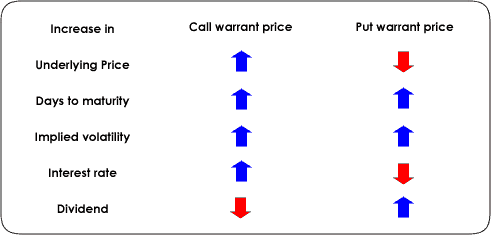
There are 5 factors that affect the price of warrants (Don’t know what are warrants? Click here). The first three factors are the more influential ones as compared to the last two.
You might also like


1) Underlying price
This is the most obvious factor since anyone that buys a warrant expects the underlying stock to move in a particular direction. Remember every warrant has a strike price? The difference between the strike price and the underlying price is the intrinsic value of the warrant. Since strike price is fixed, the only way for changes in a warrant’s intrinsic value is through the changes in underlying price.
- For a call warrant: Underlying price increases, warrant price increases
- For a put warrant: Underlying price decreases, warrant price increases
2) Days to maturity
As we know warrants have expiry dates, days to maturity simply means the remaining number of days a particular warrant has to its expiry date. A warrant, besides having an intrinsic value, has time value which is related to the number of days to maturity. The longer the days to maturity, the higher the time value of the warrant.
Longer the days to maturity, higher the price of warrant (for both call and put warrants)
3) Implied volatility
This is a market expectation of the volatility of the underlying stock in the near future – it is an expected value, that is why the name “implied” is used. A volatile stock is means its price is not stable which always fluctuate with much price movement. Hence, a volatile underlying stock has more chance to reach the strike price.
The higher the implied volatility for an underlying stock, the higher the price of the warrant.
4) Interest rate
This factor is not as influential as the first three factors as mentioned in the opening. The reason is that interest rate remains fairly constant in the near term and since warrants are short term securities, they are unlikely to encounter significant changes. The changes in warrant prices in relations to interest rate fluctuations is to compensate the opportunity cost incurred by the warrant holder.
- For a call warrant: interest rate rises, warrant price increases
- For a put warrant: interest rate rises, warrant price decreases
5) Dividend
Usually the expected dividend payout is factored into the warrant price. The changes will only come about when there is a difference in the expected payout and the actual payout. However, it is noteworthy that underlying price may be driven higher when a high dividend payout is announced. Thus, for a call warrant, the compensation of dividend payout on the warrant can be canceled out by the increase in underlying price.
- For a call warrant: dividend payout more than expected, warrant price decreases
- For a put warrant: dividend payout more than expected, warrant price increases


